Last week, we shared a fun fact that surprises a lot of homeowners:
Circuit breakers don’t actually protect your appliances—they protect the wiring inside your walls.
That naturally leads to another question.
If a breaker is protecting your home’s wiring, what should you do when it trips?
The good news is that a tripped breaker doesn’t automatically mean there’s a serious electrical problem. In many cases, it simply means the breaker did exactly what it was designed to do.
Knowing how to properly reset a breaker—and knowing when not to—can save you time while helping keep your home’s electrical system safe.
First, What Does a Tripped Breaker Look Like?
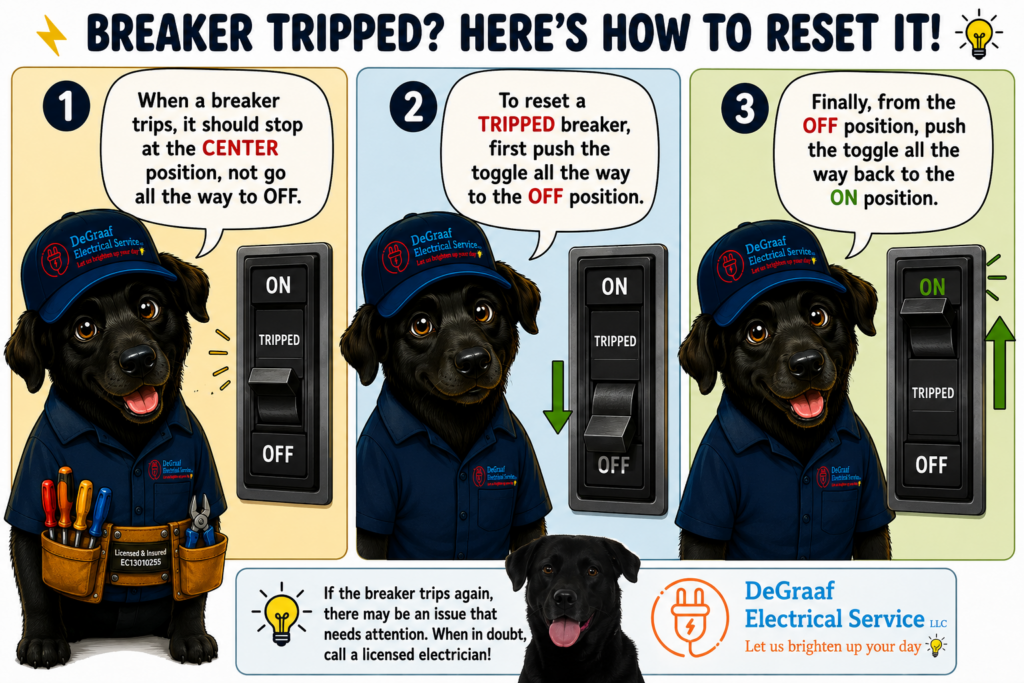
One of the biggest misconceptions is that a tripped breaker flips completely to the OFF position.
Usually, it doesn’t.
Instead, it stops somewhere between ON and OFF. Depending on your panel, it may only be slightly out of line with the other breakers, making it easy to overlook.
If one area of your home suddenly loses power, it’s worth taking a careful look at your electrical panel before assuming something more serious has happened.
How to Safely Reset a Tripped Breaker
Step 1: Locate the Tripped Breaker
Open your electrical panel and find the breaker that’s sitting between the ON and OFF positions.
Sometimes it’s only slightly moved, so compare it with the breakers around it.
Step 2: Push the Breaker Completely to OFF
This is the step many people miss.
Before the breaker can be turned back on, its internal mechanism has to be reset.
Push the handle firmly all the way to the OFF position until you feel it click.
If you try to move it directly from the middle position back to ON, it usually won’t reset.
Step 3: Turn the Breaker Back ON
Once you’ve fully reset it, move the breaker firmly back to the ON position.
If everything is normal, power should return to the affected outlets, lights, or equipment.
If the breaker stays on, there’s a good chance it simply tripped because the circuit was temporarily overloaded.
Why Do Breakers Trip?
As we mentioned in last week’s fun fact, a breaker’s job is to protect the wiring inside your home—not the appliance that’s plugged into it.
Every circuit in your home is wired with conductors designed to safely carry a specific amount of electrical current.
When too much current flows through those wires, they begin to heat up.
If that continues, the insulation around the wiring can be damaged, creating a potential fire hazard.
That’s where your breaker comes in.
It constantly monitors the current flowing through the circuit. If it detects an overload, short circuit, or certain electrical faults, it shuts the power off before the wiring can overheat.
In other words, a tripped breaker is often a sign that your electrical system is doing exactly what it was designed to do.
Common Reasons a Breaker Trips
There isn’t just one reason a breaker might trip.
Some of the most common include:
- Too many devices operating on the same circuit
- A faulty appliance
- Damaged extension cords
- Loose electrical connections
- Ground faults
- Arc faults
- Short circuits
Sometimes the cause is obvious. Plugging in a space heater, microwave, and coffee maker on the same kitchen circuit, for example, can easily overload it.
Other times, the cause isn’t nearly as obvious and requires troubleshooting to locate.
What If the Breaker Trips Again?
If the breaker immediately trips after you’ve reset it, resist the temptation to keep turning it back on.
A breaker that trips repeatedly is usually telling you that something still isn’t right.
Start by unplugging anything on that circuit that you can safely disconnect. Then try resetting the breaker again.
If it now stays on, plug your devices back in one at a time until you find the one causing the problem.
If the breaker continues tripping even with everything unplugged, the issue is likely somewhere within the circuit itself and should be inspected.
Repeatedly forcing a breaker back on without addressing the cause can allow an electrical problem to get worse.
If the breaker continues tripping even with everything unplugged, the issue is likely somewhere within the circuit itself and should be inspected.
Whatever you do, don’t try to “solve” the problem by installing a larger breaker.
A Bigger Breaker Is Not the Solution
One mistake we occasionally hear about is the idea of replacing a tripping breaker with a larger one—for example, swapping a 20-amp breaker for a 30-amp breaker.
This is not a safe fix and can create a serious fire hazard.
Remember what we talked about earlier: the breaker’s job is to protect the wiring inside your walls.
The wiring on a circuit is sized to safely carry a certain amount of current. The breaker is selected to match that wiring.
If you install a larger breaker without also replacing the wiring with conductors designed for that higher amperage, the breaker may allow more current to flow than the wiring was designed to safely handle. Instead of tripping when it should, the wiring can overheat inside the walls before the breaker ever turns off the power.
In other words, installing a larger breaker doesn’t solve the overload—it simply removes the protection the wiring was designed to have.
If a breaker keeps tripping, the solution is to determine why it’s tripping. That could mean reducing the electrical load on the circuit, repairing a wiring problem, replacing a faulty breaker if it has failed, or installing a new dedicated circuit when the existing one simply isn’t designed to handle today’s electrical demand.
A Quick “Did You Know?”
💡 A breaker isn’t trying to save your microwave, television, coffee maker, or vacuum cleaner.
Its primary purpose is to keep the wiring hidden behind your drywall from carrying more electrical current than it’s designed to handle.
That’s why it’s important to pay attention when a breaker trips. It’s often giving you valuable information about what’s happening on that circuit.
Older Homes Can Face Different Challenges
If you live in an older home, repeated breaker trips don’t necessarily mean something is broken.
Many homes were built long before today’s electrical demands.
Large televisions, gaming systems, computers, air fryers, microwaves, refrigerators, portable air conditioners, EV chargers, and countless other modern conveniences all add electrical load that older homes weren’t originally designed to support.
Sometimes the solution is simply redistributing devices across different circuits.
Other times, installing a dedicated circuit or upgrading part of the electrical system provides a safer, more reliable long-term solution.
When Should You Call an Electrician?
It’s a good idea to have a breaker inspected if it:
- Won’t reset
- Trips immediately after being reset
- Trips repeatedly over several days or weeks
- Feels unusually warm
- Makes buzzing or crackling sounds
- Shows signs of burning or discoloration
- Controls equipment that suddenly stopped working for no obvious reason
Remember, the breaker itself often isn’t the problem.
More often than not, it’s simply doing its job by protecting the wiring from a problem somewhere else in the circuit.
We’re Happy to Help
If you’ve tried resetting your breaker and it still won’t stay on—or you’re experiencing frequent breaker trips—we’re happy to help.
At DeGraaf Electrical Service, we troubleshoot residential electrical problems every day throughout Pace, Milton, Pensacola, Gulf Breeze, Navarre, Cantonment, Molino, Jay, Pensacola Beach, and the surrounding areas.
Whether it’s an overloaded circuit, a faulty breaker, or a wiring issue, we’ll identify the cause and explain your options before any work begins.
Need a free estimate?
Licensed (EC13010255) & Insured
Frequently Asked Questions About Tripped Breakers
Why did my breaker trip?
A breaker trips when it detects a condition that could damage the wiring on that circuit. Common causes include overloaded circuits, faulty appliances, short circuits, ground faults, or arc faults. In many cases, the breaker is doing exactly what it was designed to do—protecting your home’s electrical wiring.
Why won’t my breaker reset?
The most common reason is that the breaker wasn’t pushed completely to the OFF position before being turned back ON.
If you’ve done that and it still won’t reset, unplug everything on that circuit and try again. If the breaker continues to trip or won’t stay on, there may be a wiring problem, a faulty appliance, or another electrical issue that should be inspected.
Is it normal for a breaker to trip occasionally?
Yes. A breaker can trip occasionally if a circuit becomes temporarily overloaded.
However, if the same breaker trips repeatedly, it’s a sign that something needs attention. Repeated trips should not be ignored.
Can I replace a 20-amp breaker with a 30-amp breaker?
No.
Simply installing a larger breaker is not a safe solution to an overloaded circuit.
Breakers are selected to match the size of the wiring they’re protecting. Installing a larger breaker without upgrading the wiring can allow the wires to overheat before the breaker trips, creating a potential fire hazard.
If a breaker keeps tripping, the cause should be identified and corrected rather than bypassing the protection.
Why does my breaker trip when I use my microwave, air fryer, or space heater?
These appliances draw a significant amount of electrical current.
If multiple high-power appliances are operating on the same circuit, the total electrical load may exceed what the circuit is designed to handle, causing the breaker to trip.
Sometimes redistributing appliances solves the problem. In other cases, installing a dedicated circuit may be the best long-term solution.
Can a breaker wear out?
Yes.
Although breakers are designed to last for many years, they can eventually fail due to age, repeated tripping, corrosion, or internal mechanical wear.
A licensed electrician can determine whether the breaker itself has failed or whether another issue is causing the problem.
Is it safe to keep resetting a breaker?
If a breaker trips once because of a temporary overload, resetting it is usually fine.
If it trips repeatedly, however, continually resetting it without identifying the cause is not recommended. The breaker is telling you there’s a problem that needs to be addressed.