When something electrical stops working, the obvious assumption is usually that the thing that stopped working is the problem. An outlet doesn’t have power, so the outlet must be bad. A breaker keeps tripping, so maybe the breaker needs to be replaced. A light isn’t working, so there must be something wrong with the fixture.
Sometimes it really is that simple. Quite often, it isn’t.
Electrical circuits are interconnected, and a problem at one point in a circuit can cause symptoms somewhere else entirely. A loose connection at one receptacle can affect other devices downstream. A breaker that keeps tripping may be doing exactly what it is designed to do because something else on the circuit has failed. Flickering lights throughout a home can sometimes be traced back to a single loose neutral connection.
That’s why electrical troubleshooting is less about replacing whatever appears to be broken and more about determining why the problem is happening in the first place.
Where Electrical Troubleshooting Starts
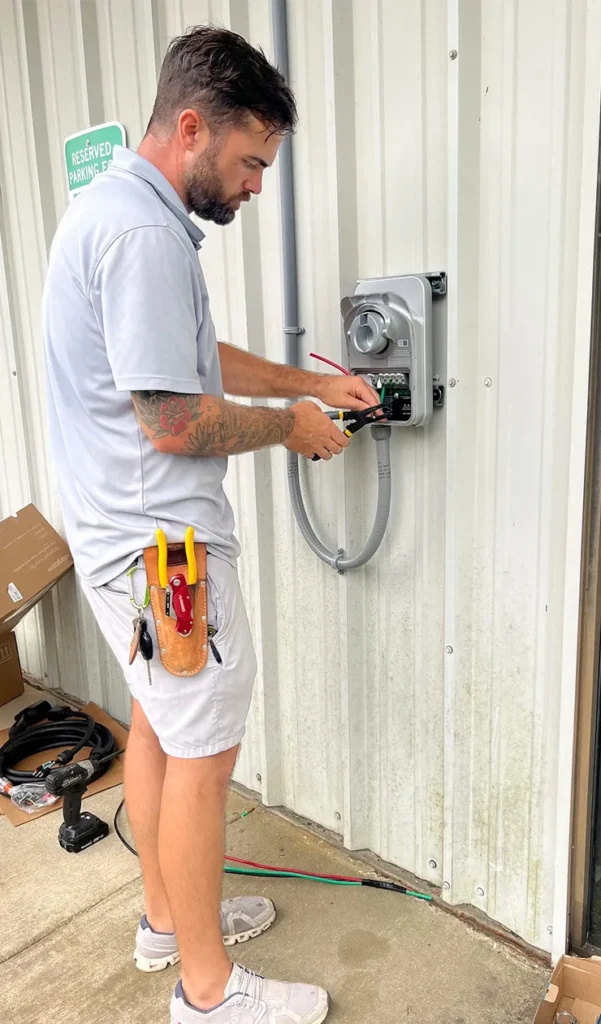
When we arrive for a troubleshooting call, one of the first things our electrician will usually do is ask the homeowner to describe what’s happening—even if they already explained everything to us when they scheduled the appointment.
There’s a reason we ask again.
Something may have changed since the original call. An outlet that wasn’t working yesterday may have started working intermittently. Another light may have begun flickering. A breaker may have tripped again. The homeowner may also have noticed a detail they didn’t think was important when they first called.
Those details can help determine where it makes the most sense to start looking.
There isn’t one universal checklist that begins at the electrical panel and works through the house in the same order every time. Troubleshooting depends on the symptoms.
If a receptacle isn’t working, for example, it generally makes sense to start there. We can remove the receptacle and look for physical damage, loose terminations or damaged conductors in the box, and test whether power is actually reaching it.
If there’s proper power in the box but the receptacle isn’t functioning, the receptacle itself may simply have failed. If there’s no power there, replacing the receptacle isn’t going to solve anything. Now we have to work backward and determine where the power was lost and why.
That distinction is a big part of troubleshooting.
Sometimes the Problem Really Is the Device
Receptacles, switches, breakers and light fixtures don’t last forever.
We regularly find switches that have begun to fail internally or have poor connections at their terminals. GFCI receptacles can fail and refuse to reset. Standard receptacles can wear out or become damaged. Circuit breakers can eventually fail as well.
Lighting has its own set of possibilities. If an older fluorescent fixture stops working, for example, the problem may be a failed ballast rather than the wiring supplying it. Depending on the fixture and its condition, we will often recommend retrofitting older fluorescent lighting to LED rather than investing in aging fluorescent components.
In cases like these, troubleshooting may be relatively straightforward.
But the same symptoms can also have considerably less obvious causes.
When the Problem Is Somewhere Else on the Circuit
A dead outlet doesn’t necessarily mean there’s anything wrong with that outlet.
If power isn’t reaching it, the problem may be at another point on the circuit. A connection can loosen. Another device can fail. A conductor can be damaged. Somewhere along the path between the electrical panel and the device that isn’t working, continuity or power has been lost.
Finding that point can take considerably longer than repairing it once it’s found.
This is especially true when the problem is hidden. Damage to wiring in an attic, for example, can be much more difficult to locate than a visibly damaged receptacle sitting directly in front of us.
Older wiring methods can add another layer to the process. Switch loops and other wiring configurations that were commonly used in the past don’t necessarily resemble the way someone might expect the circuit to be arranged today. Add decades of repairs, renovations and alterations by previous homeowners, handymen or contractors, and tracing a circuit can sometimes become a project of its own.
That’s one reason the amount of time required for troubleshooting can vary so much. Two customers can call us with what sounds like exactly the same problem—“this outlet doesn’t work”—and have two completely different causes.
A Tripping Breaker Doesn’t Automatically Mean a Bad Breaker
Repeatedly tripping breakers are another good example.
Sometimes the breaker itself has failed and needs to be replaced. But a breaker can also trip because of a loose connection, a failed receptacle or another problem on the circuit.
And sometimes there isn’t a failed electrical component at all.
A kitchen circuit being asked to supply a countertop microwave, air fryer, coffee maker and toaster at the same time can simply be overloaded. In that situation, the breaker is doing its job by opening the circuit when the load exceeds what the circuit is designed to carry.
Replacing it with a larger breaker is not an appropriate solution unless the conductors and entire circuit are designed for that larger overcurrent protection. The breaker is there to protect the circuit wiring, and increasing its size without addressing the actual problem can allow the conductors to carry more current than they are intended to handle.
The important question isn’t simply “Why does this breaker keep tripping?” It’s “What is happening on this circuit that is causing it to trip?”
Loose Connections Can Cause Problems Far From the Source
Loose connections are another problem we encounter fairly regularly, particularly loose neutrals.
Depending on where that connection is located, the symptoms may affect one circuit or appear throughout a much larger portion of the home. Lights may flicker, electronics may behave unpredictably, or power may seem to come and go.
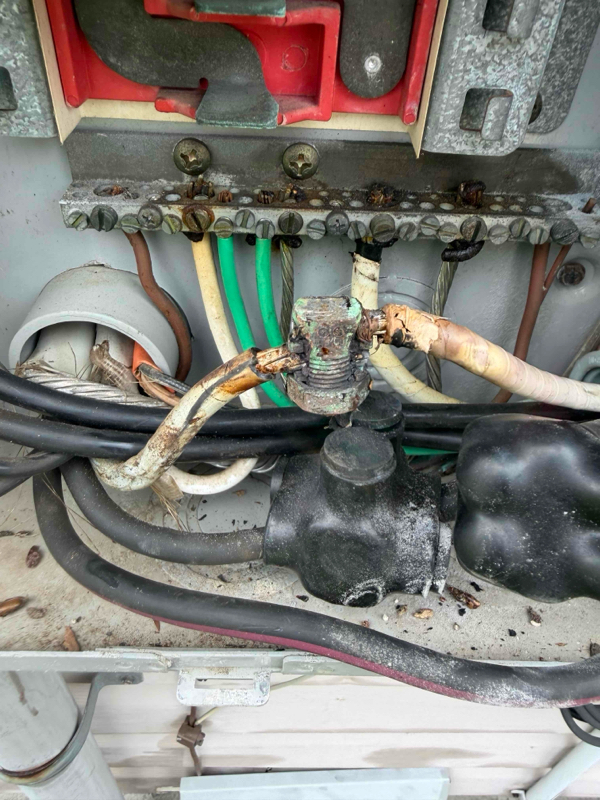
We recently encountered a particularly good example of this. A homeowner was experiencing flickering lights along with computers and printers repeatedly losing power and rebooting. Because the symptoms were occurring throughout the house, the homeowner initially suspected a problem with the utility’s equipment.
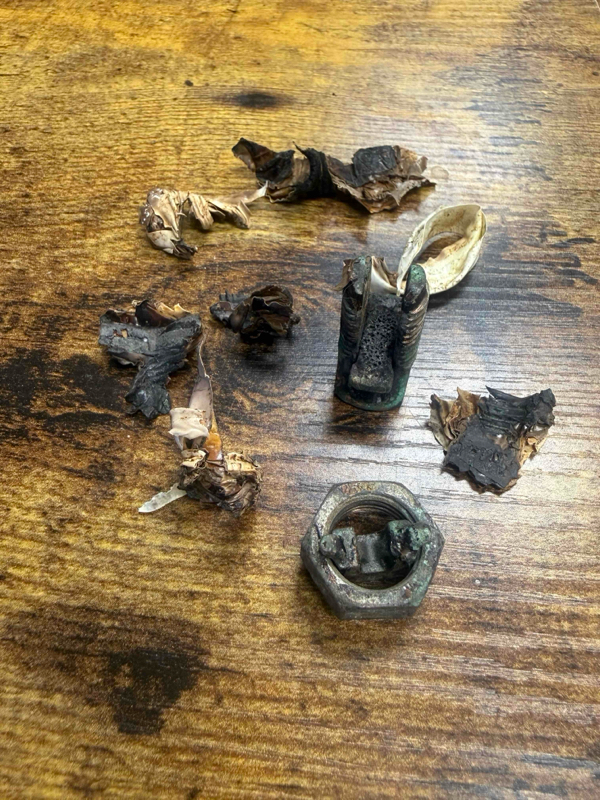
The problem ultimately traced back to a loose neutral connection at a split-bolt connector. The poor connection had been arcing and generating enough heat to badly damage the connector.
One failed connection created symptoms that appeared throughout the home.
That’s also why simply replacing whichever device appears to be malfunctioning isn’t always an effective approach. The visible symptom and the actual source of the problem may be nowhere near each other.
Sometimes the Electrical System Isn’t the Problem
Troubleshooting also occasionally ends with us determining that there isn’t an electrical repair for us to make.
If an HVAC unit isn’t operating, for example, we can determine whether the appropriate power is reaching the equipment. If the electrical supply is correct but the unit itself isn’t functioning, the next call may need to be to an HVAC company rather than an electrician.
The same thing happens with appliances. A refrigerator or microwave that suddenly stops working may make a homeowner understandably suspect the receptacle or circuit. Sometimes we test it and find that the electrical supply is perfectly fine—the appliance itself has failed.
We’ve even had a call for a repeatedly tripping breaker that ultimately turned out to be caused by a refrigerator that was failing. There was nothing wrong with the circuit. The refrigerator was causing the breaker to trip.
It may not be the answer the homeowner was hoping for, but ruling out the home’s electrical system is still an answer. It prevents someone from paying for electrical repairs they don’t need and gives them a clear direction for what to do next.
Newer Electrical Protection Can Reveal Problems With Older Appliances
Another situation we sometimes encounter involves older appliances being used in newer homes.
Modern residential circuits have considerably more GFCI and AFCI protection than homes built under older electrical codes. Those devices are designed to respond to certain conditions that an ordinary circuit breaker may not detect.
An older appliance with an aging motor, deteriorating components or leakage current may have operated for years on an older circuit without an apparent problem and then begin causing an AFCI- or GFCI-protected circuit to trip.
That doesn’t automatically mean the new breaker or GFCI is defective. Sometimes the newer protective device is responding to a condition created by the older appliance.
Again, the goal of troubleshooting is to figure out which side of that equation actually has the problem before replacing anything.
Why Experience Matters in Electrical Troubleshooting
Electrical troubleshooting requires knowing how a circuit is supposed to work, but it also requires recognizing the many ways it can go wrong.
Homes in the Pace, Milton and Pensacola area weren’t all built at the same time or under the same version of the electrical code. Over the years, they may also have had additions, renovations, panel replacements, DIY work and repairs performed by any number of different people.
The electrician standing in front of a dead receptacle today may be looking at the end result of several decades of changes.
Testing provides the information needed to narrow down the problem, but experience helps make sense of those results and determine where to look next. Sometimes the answer is apparent within a few minutes. Other times, finding one bad connection requires tracing a circuit through several devices or tracking wiring through parts of the house that aren’t particularly easy to access.
That’s the nature of troubleshooting: finding the problem can sometimes take considerably longer than fixing it.
When to Call an Electrician for an Electrical Problem
Not every electrical oddity means something catastrophic is happening, and I don’t think it’s helpful to tell homeowners that every flickering light or tripped breaker is an impending fire.
It is worth paying attention when something changes, though.
An outlet that suddenly stops working, a GFCI that won’t reset, a breaker that repeatedly trips, lights that begin flickering without an obvious reason, switches or receptacles that become warm, intermittent power, buzzing or signs of overheating are all reasonable reasons to have the problem investigated.
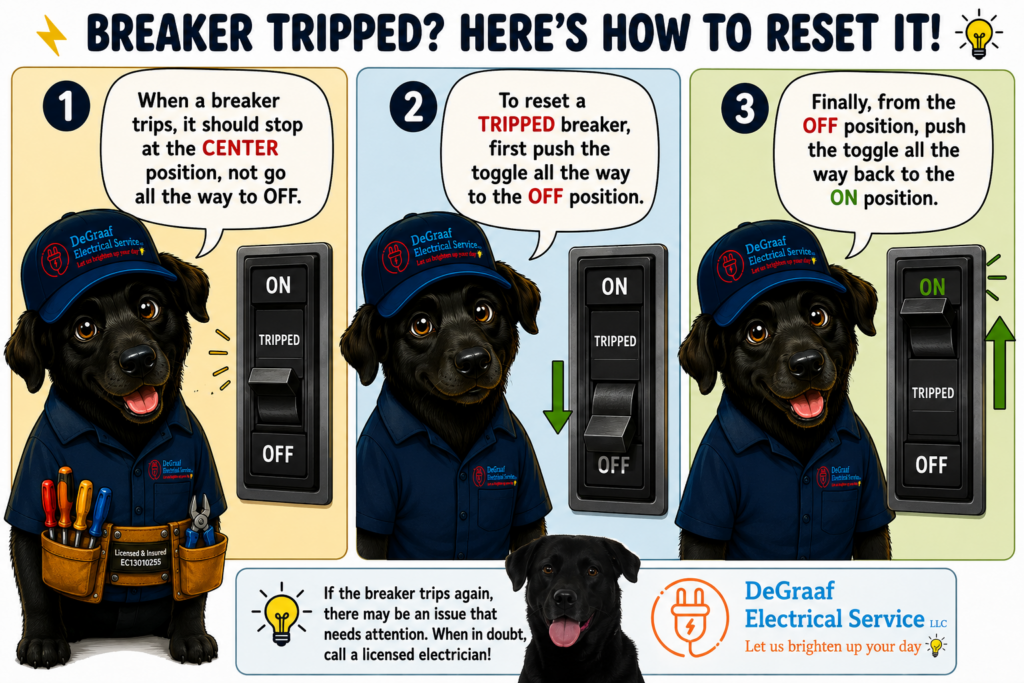
And if a breaker trips again after being properly reset, repeatedly resetting it without determining why it is tripping isn’t a solution.
Electrical Troubleshooting in Pace, Milton and Pensacola
DeGraaf Electrical Service provides residential electrical troubleshooting and repairs throughout Pace, Milton, Pensacola and the surrounding areas.
We are insured and operate under Florida Electrical Contractor License #EC13010255. Florida contractor licenses can be verified through the Florida Department of Business and Professional Regulation.
If something in your home’s electrical system isn’t working the way it should and you don’t know why, give us a call at (850) 995-4227.
Frequently Asked Questions About Electrical Troubleshooting
Why does an outlet suddenly stop working?
There are several possibilities. The receptacle itself may have failed, a connection may have come loose, a GFCI protecting the circuit may have tripped, or power may have been lost somewhere else on the circuit. An electrician can test whether power is reaching the receptacle and, if it isn’t, trace the circuit to determine where the problem begins.
Why won’t my GFCI outlet reset?
A GFCI that won’t reset doesn’t necessarily mean the GFCI itself is bad. The device may have failed, but it may also be detecting a problem on the circuit or may not have the power it needs to reset. Troubleshooting helps determine whether the GFCI needs to be replaced or whether something else is causing the problem.
Why does my circuit breaker keep tripping?
A breaker can trip for several reasons, including an overloaded circuit, a loose or damaged connection, a problem with a device or appliance on the circuit, damaged wiring, or a failing breaker. Repeatedly resetting the breaker doesn’t address whatever is causing it to trip. If it continues happening, the cause should be investigated.
Can I just replace a tripping breaker with a larger one?
No. A larger breaker should not be installed simply to stop a circuit from tripping. Breakers are sized to protect the conductors and equipment on the circuit. Increasing the breaker size without verifying that the entire circuit is designed for it can allow the wiring to carry more current than it is rated for and create a fire hazard.
Why are my lights flickering if the bulbs are good?
The problem may be at the fixture, switch or another connection on the circuit. If lights are flickering in several areas of the home, the cause may be farther upstream and can sometimes involve a loose neutral or another connection affecting multiple circuits. The pattern of the flickering—and what else in the home is affected—can provide important clues during troubleshooting.
Why does my breaker trip when I use several kitchen appliances at once?
Countertop appliances can draw a surprising amount of power. Running a microwave, air fryer, toaster and coffee maker at the same time can exceed the capacity of the circuit they’re sharing. In that situation, the breaker may simply be doing its job. If you’re regularly running into this problem, an electrician can determine what is on the circuit and whether additional circuits would be appropriate.
Why does an older appliance trip the breaker in my newer house?
Newer homes have AFCI and GFCI protection in more locations than older homes did. An older appliance with an aging motor, deteriorating components or leakage current may cause one of these protective devices to trip even though the appliance appeared to operate normally on an older electrical system. Troubleshooting can help determine whether the problem is with the circuit, the protective device or the appliance itself.
How long does electrical troubleshooting take?
It depends entirely on the problem. Sometimes the cause is apparent fairly quickly, such as a failed receptacle or loose connection directly behind a device. Other problems require tracing a circuit through multiple devices, testing connections or locating wiring in attics and other difficult-to-access areas. Two homes with the same apparent symptom can require very different amounts of troubleshooting to find the cause.
What happens if the electrician determines the electrical system isn’t the problem?
That happens sometimes. If we verify that the proper power is reaching an appliance or piece of equipment but the equipment still isn’t operating, the problem may be with the equipment itself. At that point, you may need an appliance repair technician, HVAC contractor or another appropriate trade. Knowing that the electrical supply is working properly at least eliminates one possible cause and helps determine what to do next.
What information should I give the electrician about an electrical problem?
Tell us everything you’ve noticed, even if you aren’t sure it’s related. When the problem started, whether it’s constant or intermittent, what was running when it happened, which rooms or devices are affected, whether a breaker or GFCI has tripped, and whether anything has changed since you first noticed the problem can all be useful. You don’t need to diagnose it yourself—that’s what troubleshooting is for.